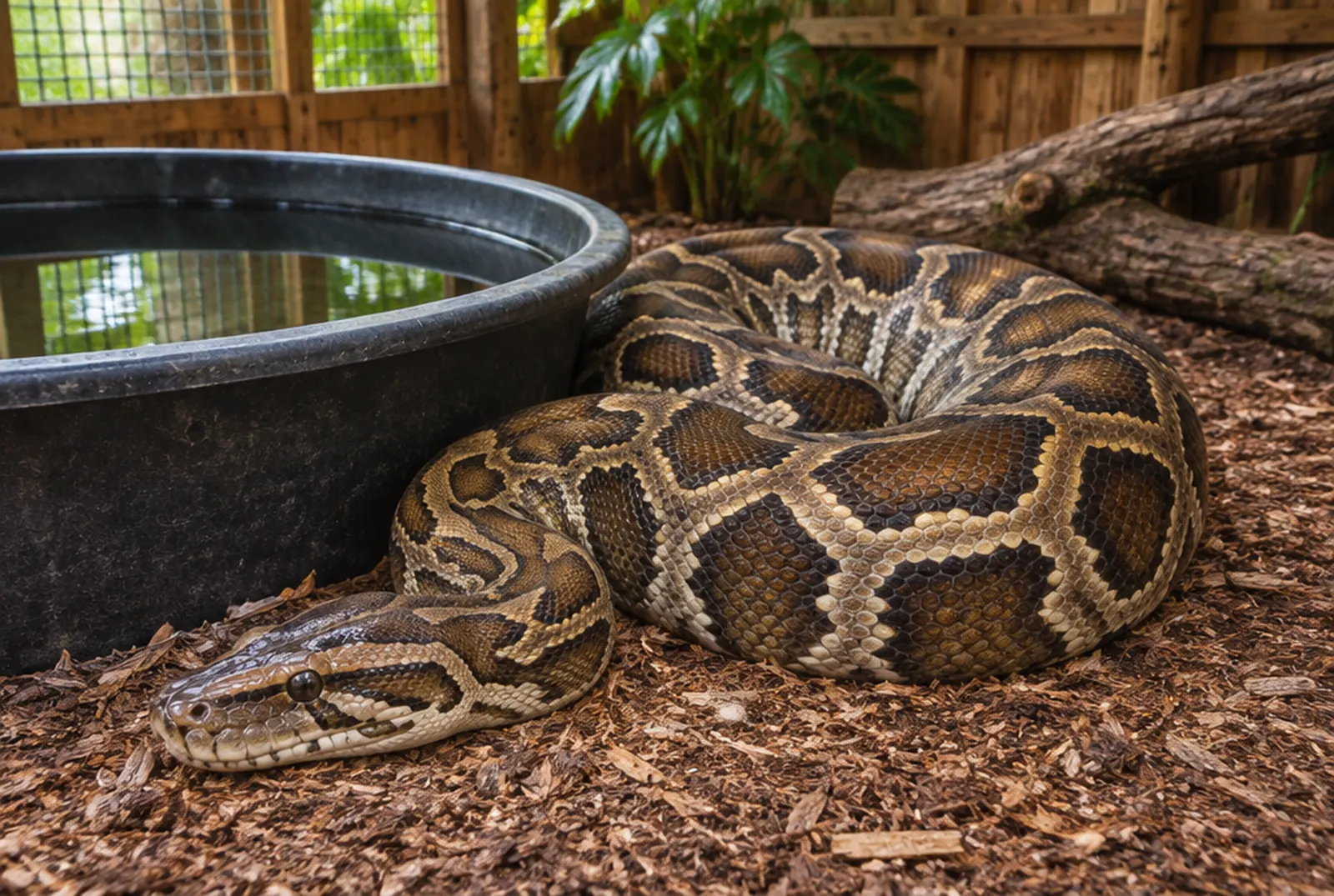
Not a beginner snake. Burmese pythons are among the largest snakes in the world. Their care isn't complicated, but their size makes housing, feeding and handling a serious long-term commitment, and a safety issue. Check your local laws before buying; some places restrict or ban them.
Is a Burmese python right for you?
Burmese pythons (Python bivittatus) are native to Southeast Asia, from eastern India through Myanmar to southern China and Indonesia, where they live in grasslands, marshes and forests near water. Captive-bred "burms" are usually docile and are popular for their calm temperament and huge range of morphs.
The reality check:
- A 20-inch hatchling can reach 8 ft within a couple of years and 12–16 ft as an adult.
- Adults can weigh 100–200 lb, need an enclosure the size of a bed or larger, and eat rabbits.
- Rehoming a giant snake is very difficult; rescues are often full.
Legal status
- United States: listed as an injurious species under the Lacey Act, which restricts importation and interstate transport. Some states, including Florida, prohibit them as pets.
- Elsewhere: rules vary widely by country and region. Some require a licence, registration or a secure-housing standard for large constrictors.
Always confirm the law where you live before buying.
Enclosure
Because adult size varies so much, size the enclosure to the snake:
- Length = at least the snake's length
- Width = at least half the snake's length
- Height = as tall as practical (burms climb when young and appreciate height)
| Snake | Enclosure |
|---|---|
| Hatchling–juvenile | Secure tub or 4×2×2 ft, upgraded as it grows |
| Smaller adult (up to ~8 ft) | 8×4×4 ft |
| Large adult (12 ft+) | 10–12×5×4 ft or a custom room-style enclosure |
Use a strong, lockable, front-opening enclosure. Burmese pythons are powerful and will push through weak doors or lids. Provide a water tub large enough to soak the whole body, sturdy hides, and climbing branches for younger snakes.
Heating and lighting
- Basking surface: 90–95°F (32–35°C)
- Cool side: 75–80°F (24–27°C)
- Night: don't let the enclosure drop much below about 75°F (24°C)
Large enclosures need multiple heat sources: halogen flood bulbs or radiant heat panels over the basking area, all on thermostats, with guards so the snake can't wrap around a bulb. Low-level UVB with a 12-hour day/night cycle is beneficial.
Humidity
Keep humidity around 50–70%, a little higher before a shed. A large water tub plus a moisture-holding substrate (cypress mulch, coconut husk or a soil mix) usually achieves this. Avoid constantly wet substrate, which causes scale problems.
Feeding
Feed frozen-thawed prey. Prey size should be roughly the width of the snake's widest point.
| Snake | Prey | Frequency |
|---|---|---|
| Hatchling | Adult mouse to rat pup | Every 5–7 days |
| Juvenile | Rats, increasing in size | Every 7–10 days |
| Adult | Large rats, rabbits | Every 2–4 weeks |
Burmese pythons have a strong feeding response and obesity is very common. Feed less often as the snake matures, and judge by body condition: a healthy burm is muscular and rounded, not with fat folds along the sides.
Handling and safety
- Two-person rule: have at least one other adult present whenever you handle or feed a snake of about 8 ft or longer.
- Use tongs for feeding, and a snake hook to "tap train" the snake before you reach in, so it knows it's not feeding time.
- Never handle smelling of prey, and never open the enclosure when a hungry burm is in a feeding response.
- Support the body along its length; large snakes should be handled by more than one person.
Common mistakes
- Buying a hatchling without planning for an adult.
- Weak or unlocked enclosures.
- Power-feeding, which leads to obesity and a shortened life.
- Solo handling or feeding of large snakes.
- Not checking local laws.
Signs of a healthy Burmese python
Clear eyes outside of shed, complete sheds, no wheezing or mucus, a firm and muscular body, and regular feeding. Open-mouth breathing, bubbles at the nostrils, mouth swelling, or regurgitation warrant a reptile vet.
FAQ
How big do Burmese pythons get? Most reach 12–16 ft, with large females bigger and well over 100 lb.
What size enclosure does a Burmese python need? Length at least the snake's length and width at least half; 8×4×4 ft for smaller adults, 10–12 ft+ for large females.
Is it legal to own a Burmese python? It depends where you live; they're restricted in the US and some other places. Check local law first.