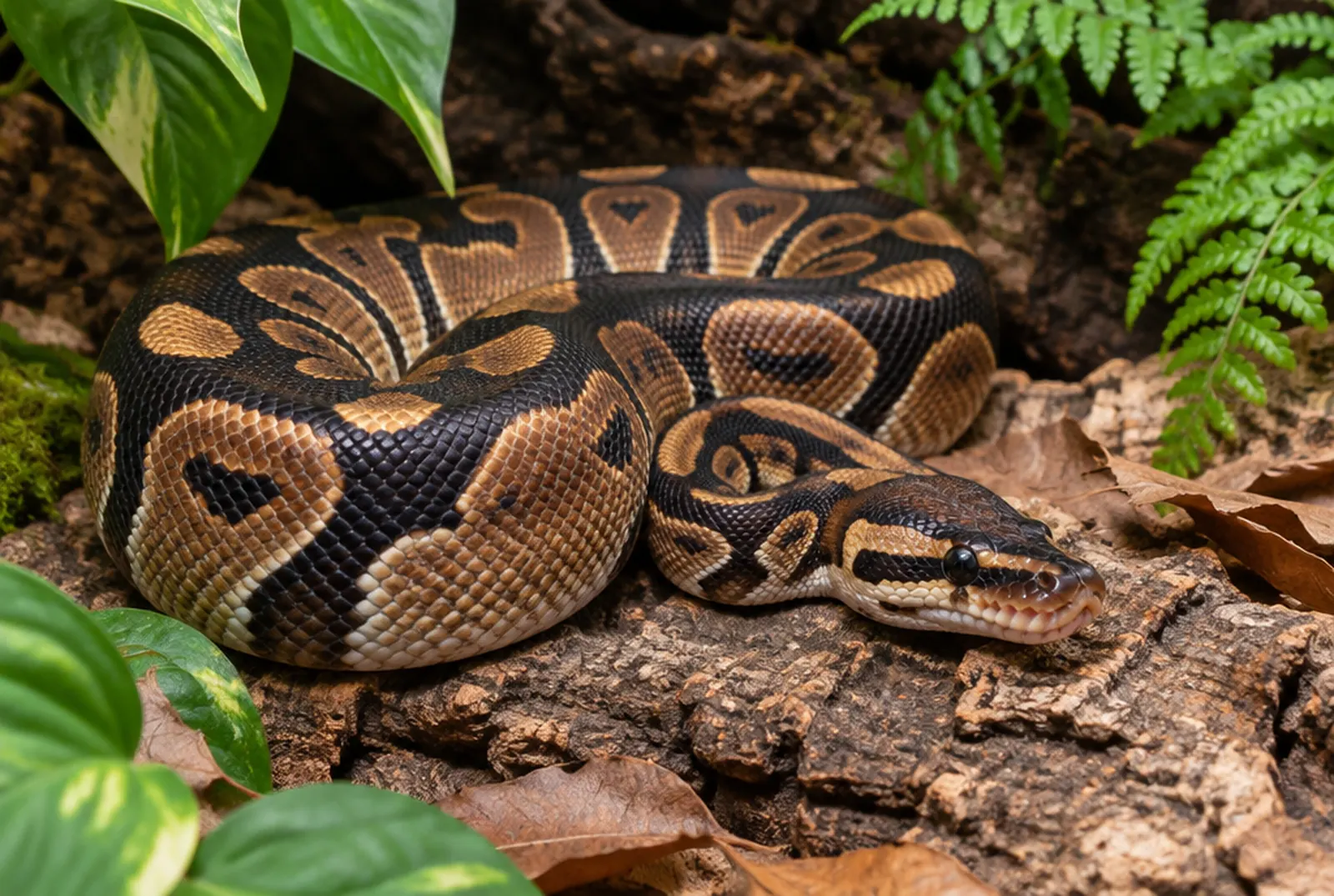
Is a ball python right for you?
Ball pythons (Python regius) come from the grasslands and open forests of West and Central Africa. They're docile, slow-moving and rarely bite, and they stay a manageable size. They also live a very long time: 20–30 years is normal and some reach 40+.
They eat whole rodents (usually frozen and thawed), so you'll need freezer space and to be comfortable with that.
Enclosure
| Snake | Enclosure |
|---|---|
| Hatchling / juvenile (under ~500 g) | 20–40 gallons, very cluttered |
| Adult | 4×2×2 ft (120 gallons) minimum |
Ball pythons feel exposed in big, empty spaces, which is why they sometimes stop eating when moved into a large enclosure. The fix isn't a smaller tank; it's more cover: plenty of hides, plants, cork bark and branches so the snake can move without ever feeling in the open.
PVC enclosures are popular because they hold heat and humidity far better than glass with a screen top. If you use a glass tank, cover most of the screen top to stop humidity escaping.
Provide at least two snug hides (one warm, one cool). Hides should be just big enough for the snake to fit inside with its body touching the walls.
Heating
- Warm side / basking surface: 88–92°F (31–33°C)
- Warm-side air: around 80–85°F (27–29°C)
- Cool side: 75–80°F (24–27°C)
- Night: a few degrees cooler is fine; don't let the cool side drop below about 72°F (22°C)
Overhead heat (a deep heat projector or halogen bulb with a guard) or a radiant heat panel works well and doesn't dry the air out as much as some lamps. Always use a thermostat, and put a guard around any bulb so the snake can't wrap around it.
Lighting
Ball pythons don't strictly need UVB, but low-level UVB and a regular day/night light cycle can benefit them. If you add UVB, use a low-output tube with plenty of shade. Avoid colored "night bulbs"; darkness at night is better.
Humidity
Keep humidity around 60–80%, raising it slightly before a shed. Signs it's too dry: stuck shed, especially on the tail tip or eye caps. Ways to raise humidity:
- A large water bowl the snake can soak in (on the warm side increases evaporation).
- Moisture-holding substrate, lightly mixed with water.
- Covering part of any screen top.
Avoid soggy substrate: constant wetness causes scale rot.
Substrate
Coconut husk/chips, cypress mulch, or a soil-based mix all hold humidity well. Aspen is fine for dry species but breaks down and moulds in ball python humidity, so it's better avoided.
Feeding
Feed frozen-thawed rodents: they're safer than live prey, which can bite and injure snakes. Thaw in the fridge or in a sealed bag in warm water, and offer with tongs.
| Snake size | Prey size | Frequency |
|---|---|---|
| Hatchling | Hopper / small fuzzy mouse or rat pup | Every 5–7 days |
| Juvenile | Prey about the width of the snake's widest point | Every 7–10 days |
| Adult | Prey about the width of the snake's widest point | Every 2–4 weeks |
A good rule: prey should be no wider than the widest part of the snake's body and roughly 10% of its weight.
Fasting: ball pythons are famous for refusing food, especially adult males in winter and snakes about to shed. A healthy, well-weighted snake can go weeks without eating. Weigh your snake monthly on a kitchen scale; ongoing weight loss is the sign to see a vet.
Shedding
Before a shed, the eyes turn cloudy blue and the skin dulls. Leave the snake alone and hold off on feeding until it has shed. A healthy shed comes off in one piece. Retained shed usually means humidity is too low.
Handling
Wait about a week after bringing your snake home and don't handle it for 48 hours after a meal. Support the body with both hands, let the snake move through your hands, and avoid grabbing the head.
Common mistakes
- Big, empty enclosures that leave the snake feeling exposed.
- Low humidity from glass tanks with open screen tops.
- Unregulated heat or unguarded bulbs.
- Panicking over fasting and offering food constantly.
- Live feeding, which risks bites.
Signs of a healthy ball python
Clear eyes (outside of shed), clean nostrils with no bubbling or wheezing, complete sheds, and a rounded body without visible spine. Open-mouth breathing, mucus, persistent weight loss or star-gazing (holding the head at odd angles) need a reptile vet.
FAQ
What size enclosure does a ball python need? At least 4×2×2 ft (120 gallons) for an adult, packed with cover.
What humidity does a ball python need? Around 60–80%, higher before a shed.
Why won't my ball python eat? Usually stress, wrong temperatures, too little cover, an upcoming shed, or seasonal fasting. Weigh monthly and see a vet if weight drops.