ReptiGuide is reader-supported. When you buy through links on this page we may earn a commission, at no extra cost to you. Learn more.
Why UVB matters so much
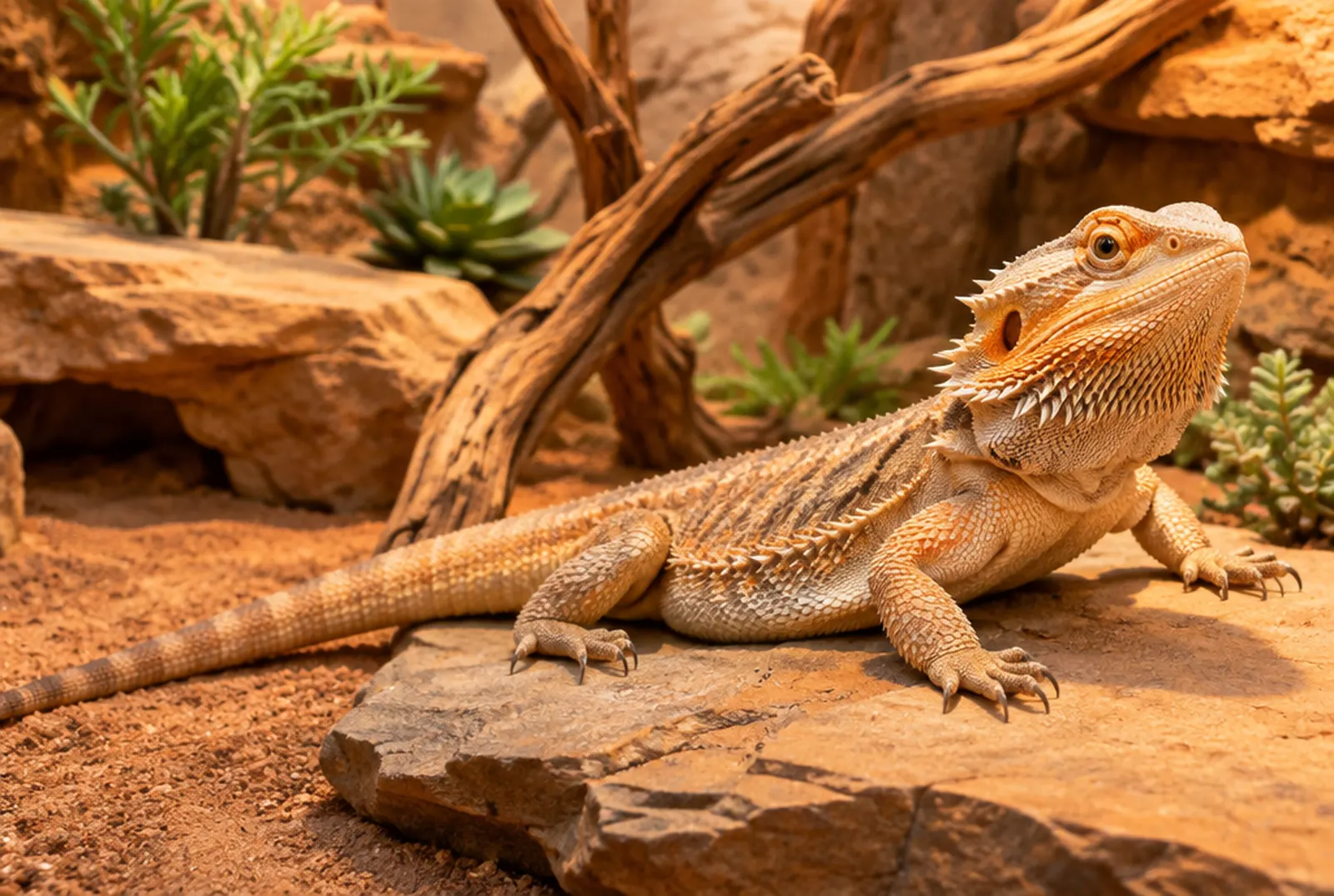
Bearded dragons are desert sun-baskers. In their skin, UVB light drives production of vitamin D3, which they need to absorb and use calcium. Without enough UVB, dragons develop metabolic bone disease (MBD): soft jaws, bent limbs, tremors and fractures. Supplements help, but they don't replace proper lighting.
The short answer
- Use a T5 high-output (HO) linear tube, not a compact coil or "UVB-in-a-screw-bulb" product.
- Choose 10–14% depending on mounting (see below).
- Cover about half to two-thirds of the enclosure's length, on the basking side.
- Mount it in a reflector fixture, inside the enclosure or above a fine mesh.
- Replace it every 12 months.
Arcadia ProT5 UVB Kit 12%
Complete fixture, reflector and 12% tube. A strong all-round choice for a 4×2×2 enclosure, especially above mesh.
Zoo Med ReptiSun T5 HO 10.0 UVB
Widely available 10% T5 HO tube; pair with a T5 HO fixture with a reflector.
10% vs 12% vs 14%
The percentage on the box describes the proportion of UVB in the tube's output, not a dose. What matters is the UV index (UVI) at your dragon's back, which depends on tube strength, reflector, mesh and distance.
| Setup | Typical choice |
|---|---|
| Tube inside the enclosure, basking spot fairly close | 10–12% T5 HO |
| Tube above a mesh top | 12–14% T5 HO |
| Tall enclosure / basking spot far from the tube | 12–14% T5 HO |
Target roughly UVI 3–6 at the basking spot, with lower levels across the rest of the enclosure so the dragon can choose. Always follow the manufacturer's recommended distance. If you want certainty, a Solarmeter 6.5 UV index meter lets you measure it directly.
Mounting: inside vs above mesh
- Inside the enclosure gives the most UVB per watt. Use a fixture with a reflector, and keep the dragon from touching the tube.
- Above mesh is common on tanks with screen tops, but mesh can block 30–50% of UVB, so you'll need a stronger tube or a shorter distance.
- Never put the UVB behind glass or plastic; it blocks UVB almost completely.
Pair UVB with the right heat
UVB and heat should overlap at the basking spot, just like sunlight in the wild. Put your halogen basking bulbs and the warm end of the UVB tube over the same platform, with a basking surface of about 100–110°F (38–43°C) for adults. A dimming thermostat keeps it there.
Common UVB mistakes
- Compact coil UVB bulbs. Their output is weak and patchy for bearded dragons.
- UVB behind glass.
- Tube too far away above thick mesh.
- Never replacing the tube. Mark the install date on the fixture.
- No shade. The dragon needs to be able to move out of the UVB zone.
FAQ
Is 10% or 12% UVB better for a bearded dragon? It depends on distance and mesh. 12–14% suits tubes above mesh or taller enclosures; 10% suits tubes inside and closer. Aim for UVI 3–6 at the basking spot.
How often should I replace a bearded dragon UVB bulb? About every 12 months.
Can UVB go through glass? No. Mount the tube inside or over mesh.
Back to the full bearded dragon care sheet.